Collection and delivery wins work you would never otherwise see: the customer who cannot get a lift back from the garage, the business with three vans and no time, the older customer who no longer drives far. It is also where the arguments start. “That scratch wasn't there.” “It had half a tank when you took it.” “Where's my locking wheel nut key?”
Running the service well is mostly about two things: recording the car properly at the customer's door, and planning the runs as part of the workshop day rather than squeezing them in around it. Here is how to do both.
Decide who it is for and what it costs
Collection and delivery suits some customers far better than others:
- Commuters who cannot lose a morning dropping the car off.
- Business and fleet accounts, where downtime costs them more than your fee.
- Households with one car and no easy way back from the garage.
- Rural customers, where the nearest bus is not much help.
The cost is mainly the driver's time, and often a second person to drop off or pick up the driver. Decide up front whether you charge for it, include it free within a set radius, or include it on larger jobs. Whatever you choose, write it down so the front desk quotes the same thing every time.
Check with your insurer that your motor trade policy covers your staff driving customers' cars on the road, and which drivers it names. Do this before your first run, not after your first claim.
Set the rules before the first run
Most collection problems come from customers not knowing what to expect. Agree these and put them in the booking confirmation:
- The window. Collections in a morning window and deliveries in an afternoon one are easier to plan than exact times.
- The keys. Handed over in person, left with a neighbour or in a key safe. Agree it before the driver sets off.
- The locking wheel nut. Ask where it is when the job is booked. Finding out on the ramp that nobody knows costs you time you cannot bill.
- Valuables. Ask the customer to empty the car. You do not want to be responsible for a laptop on the back seat.
- Payment. Agree that the car comes back once the invoice is paid, and make paying easy before the driver leaves.
- No-shows. Say what happens if nobody is home and the keys are not where they should be.
Record the car at the door
This is the part that protects you. A short, consistent check at the moment of collection, signed by the customer, settles nearly every dispute before it starts. It should cover:
- Mileage. The odometer reading at collection, so an unexpected jump is explained by the run, not by your technicians.
- Fuel level. Empty, a quarter, a half, three-quarters or full. It is the most common complaint and the easiest to settle.
- Tyres. Tread depth and pressure on each corner as the car arrives. It shows the condition before you touched it and often finds work the customer needs.
- Locking wheel nut. Where it actually is, confirmed at the car.
- Damage. Either “no damage” or a description of what is there: “scuff on the rear bumper, nearside corner”.
- Photos. All four sides, any existing damage close up, and the dashboard showing the mileage and fuel.
- The customer's signature, or a note of why there is not one, such as “keys left in the key safe”.
- The time it was collected.
Do a quicker version on delivery too: a photo of each side and the dashboard as you hand the car back. It takes two minutes and closes the loop.
Plan the runs into the workshop day
- Collect early, deliver late. Cars collected first thing are on site before the bays need them. Deliveries go in the afternoon, once the work is done and paid.
- Book the bay time after the car arrives. A collected car cannot start at 8:00 if the driver only leaves at 8:00. Book its bay slot for when it will really be there.
- Group runs by area. Two collections in the same town are one trip, not two.
- Tell the customer the driver is on the way. A quick text saves a wasted trip to an empty house.
- Get paid before the car leaves. Send the invoice with a payment link while the car is on its way back, not after it has gone.
How it works in BOOKAR
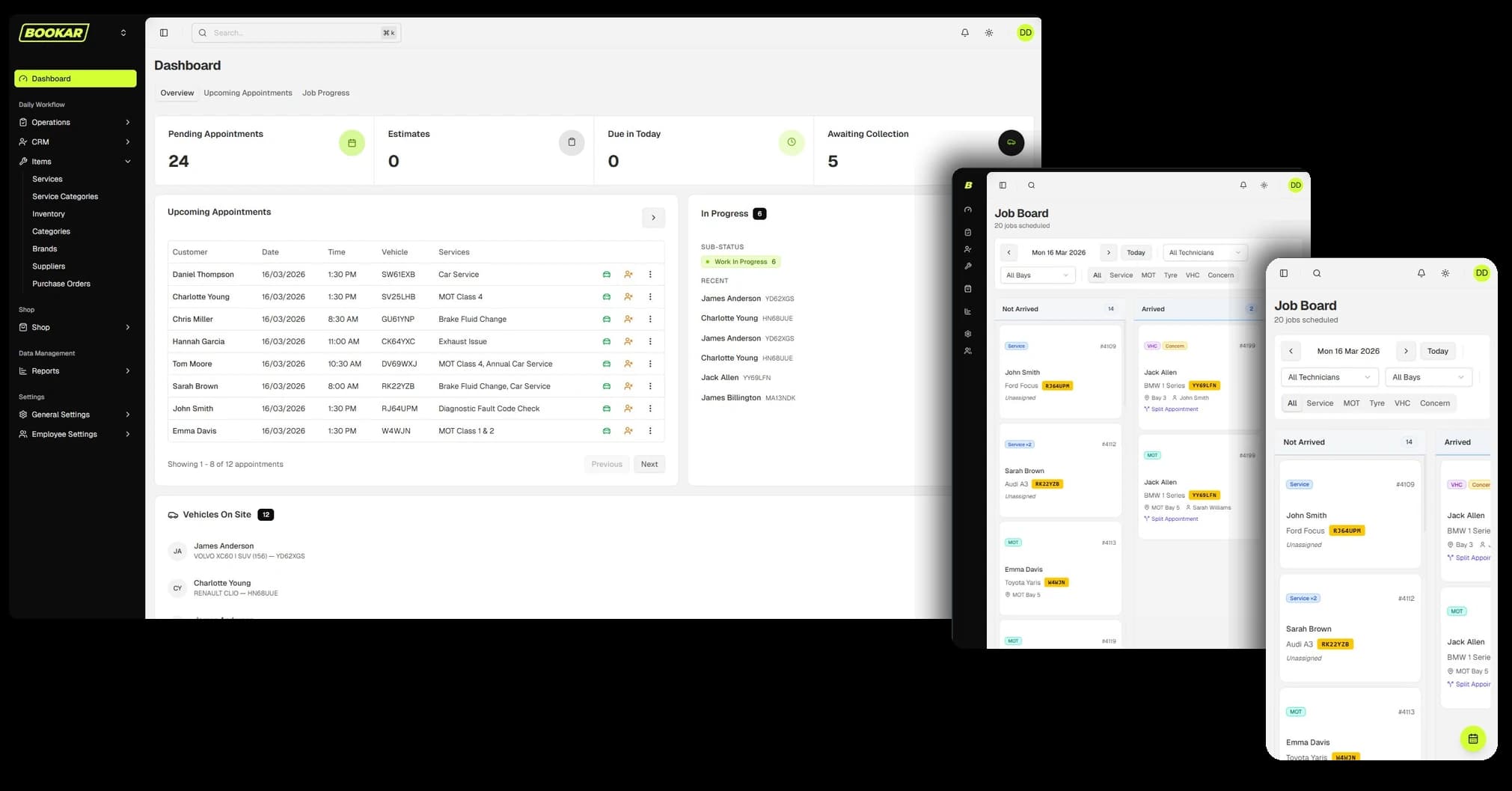
Collection and delivery is part of the BOOKAR garage management system, not a separate app. A collection or delivery is added to the work order, and the runs appear on the Driver Board: today's round, with collections above deliveries.
The driver fills in a Collection Report on their phone at the customer's door, in the order above: mileage, fuel level, each tyre's tread and pressure, where the locking wheel nut is, any damage with photos, and the customer's signature with a finger on the screen. It is saved to the work order's Files & Forms with a PDF, so the front desk can see it before the car pulls in. The locking wheel nut answer updates the work order, and it prints on the job sheet and the invoice.
A few other pieces help the service run smoothly:
- Drivers can record mileage, correct a run's time and add notes from the board.
- With Vostel connected, a collection card can ring the customer through your phone system.
- The Tracker's Needs Attention list flags overdue collections and deliveries, along with finished cars that have not been collected.
- A finished, paid car stays in Vehicles On Site until it is marked handed over, so nothing leaves without someone knowing.
- Payment links by text, through invoicing and payments, let the customer pay before the car comes back.
If you would rather lend a car than fetch one, the Courtesy Cars add-on does the same job for loans: a handover and return agreement the customer signs with a finger, and a planner showing every car's loans.
Start small
You do not need a dedicated driver on day one. Offer collection and delivery to your business accounts and a few regulars, within a short radius, on set days. Get the collection check right first. Once every run comes back with a signed report and photos, widen the radius and start promoting it to everyone else.
Collection and delivery, included in the GMS
The Driver Board and the phone Collection Report are part of BOOKAR's garage management system. See what else is included.