Ask most garage owners for their monthly target and you will get one of three answers: a figure a bit higher than last year, a figure that “feels about right”, or no figure at all. None of them tells a technician what a good day looks like. None of them tells you whether the business will make the profit you need.
There is a better way, and it is only a few lines of arithmetic. Start from what the garage costs to run, add the profit you want to keep, and work back to the number of hours the workshop has to sell. Then compare that with the hours your technicians are actually in. This post walks through it step by step, with a worked example at the end.
1. Add up what the garage costs to run
Work out a monthly figure for everything the business pays out:
- Rent or mortgage, business rates, and gas, electricity and water
- Insurance
- Technician wages, other staff wages, employer's NI and pensions
- Your own pay or drawings
- Marketing, software and subscriptions, and tools and equipment
- Loan and finance repayments, accountant and bank charges, and everything else
The one owners most often leave out is their own pay. If the plan only works because you take nothing home, it is not a plan. Your accounts are the easiest place to start. Take last year's overheads and add anything that has gone up since.
2. Add the profit you want to keep
Profit is a decision, not whatever happens to be left over. Pick a monthly figure: money for reinvestment, a buffer for a bad month, a return on the risk you are taking. Running costs plus that profit is the gross profit the business has to earn.
3. Take off what does not come from the workshop
If you earn profit from anything else, such as car sales or rent from a unit you sublet, take it off. What is left has to come from the workshop, as labour sold and profit on the parts that go with it. That figure is parts profit plus labour sales, and it is the most useful single target a garage can track.
4. Split it between labour and parts
Parts profit comes with the work. Sell more labour and you sell more parts with it. So rather than guessing two separate targets, look at your own figures for the last year: how much parts profit did you make for every £1 of labour you sold? If it was 40p, then:
Labour sales needed = parts profit plus labour sales ÷ 1.4
Use your own ratio. It varies a lot between a tyre-heavy garage, a diagnostic specialist and a general service and repair workshop.
5. Turn labour sales into hours
Divide the labour sales needed by your effective labour rate: the labour you actually sold divided by the hours you actually sold, not the rate on the board. Discounts, fixed-price MOTs, free checks and hours that went out at £0 all pull it down. Using the board rate here is the most common way to end up with a target that looks easy and never gets hit.
Hours to sell = labour sales needed ÷ effective labour rate
6. Check it against the hours your technicians are in
For each technician, count the days they are due in each month, take off holiday, sickness and training, and multiply by their hours a day. Add them up and you have the hours the workshop is in. Then:
Overall efficiency needed = hours to sell ÷ hours in
If that comes out over 100%, the plan is impossible as it stands. If it is well above what your workshop normally achieves, it is a stretch, and you should know that before you hand anyone a target.
A worked example
These numbers are made up to show the method. Use your own figures from your accounts and your reports.
- Running costs: £30,000 a month, including wages and the owner's drawings
- Profit to keep: £5,000 a month, so gross profit needed is £35,000
- No other income, so parts profit plus labour sales has to be £35,000
- Parts profit is 40p per £1 of labour: £35,000 ÷ 1.4 = £25,000 of labour sales
- Effective labour rate £80 an hour: £25,000 ÷ £80 = about 313 hours to sell a month
- Three full-time technicians on 8-hour days, with 25 days off a year each, are in about 454 hours a month between them
- 313 ÷ 454 = about 69% overall efficiency needed
That is about 104 hours sold per technician a month, or around 5.5 hours sold for every 8-hour day they are in. That is a number a technician can picture.
Now the useful bit. Run the same sum without the £5,000 profit and break-even comes out at about 59% efficiency. If this workshop typically sells 60% of the hours its technicians are in, it is only just covering its costs. At 60% it sells about 272 hours, which leaves it roughly £4,500 a month short of the plan. To make the profit at 60%, its effective labour rate would need to be about £92, not £80. All of the profit is in the hours sold above break-even, or in the rate charged for them.
Turn it into monthly and daily targets
Months are not equal. A month with two bank holidays has fewer working days than one with none, and a technician on a week's holiday cannot sell hours that week. Set targets per working day, per technician, and let the monthly total follow from the days each person is actually in.
Then measure the month so far against the target so far, not against the whole month. “£3,000 behind with eight working days left” is something you can act on. “We have done 60% of the monthly target” on the 20th means nothing until you know how many days are left.
When the numbers do not add up
The same sum shows you which levers you have:
- Effective labour rate. Stop giving hours away. Charge diagnostics properly, watch hours invoiced at £0, and make discounts something a manager approves.
- Efficiency. Have parts ready before the car arrives, give work to the technician best suited to it, and cut the time cars spend waiting for an answer from the customer.
- More work per car. Health check advisories that turn into booked work add hours without adding customers.
- Parts margin, costs, or headcount. Each changes the answer, and you can see by how much before you commit.
How BOOKAR does the sums
In BOOKAR, the plan and the reports that measure it use the same figures, so a target set in January still means something in March:
- Business Plan. Under Reports, the owner types what the garage costs to run and the profit to keep. It fills in the rest from the last 12 months and your staff records: parts profit per £1 of labour, your effective labour rate and each technician's working week. Then it works back to the gross profit, the hours to sell and each technician's share, month by month. It flags a plan that needs more hours than the technicians are in. Apply writes the results in as the targets your reports measure against.
- Technician Targets. Each technician's hours-sold target for the month or per working day, against everything invoiced on their work: labour, MOTs, tyre fitting, health checks and inspections. It shows how far ahead or behind they are, the percentage of target and the target to date, beside the hours they worked.
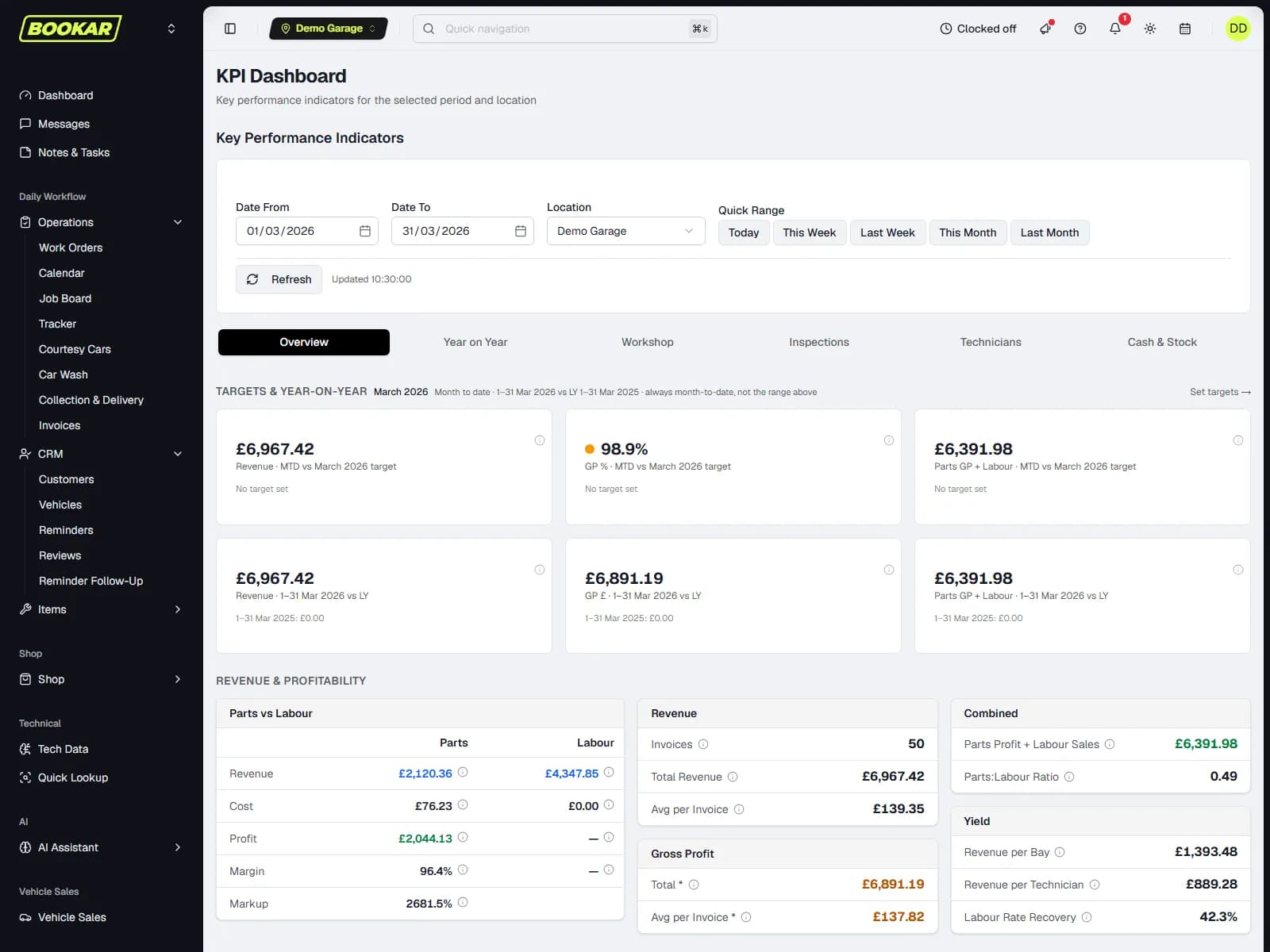
- Targets on the KPI dashboard. The month so far is measured against the target to date, with “Ahead by” or “Behind by” and what is still needed per working day left. Working days come from your opening days, closed dates and bank holidays.
- The rate you actually achieve. GP per hour sold, a target labour rate shown against the rate you are really getting, and the hours sold at £0, all on the KPI dashboard.
Targets built from your costs, measured every day
See how BOOKAR's reporting and KPI dashboard track hours sold, labour rate and profit against target.